

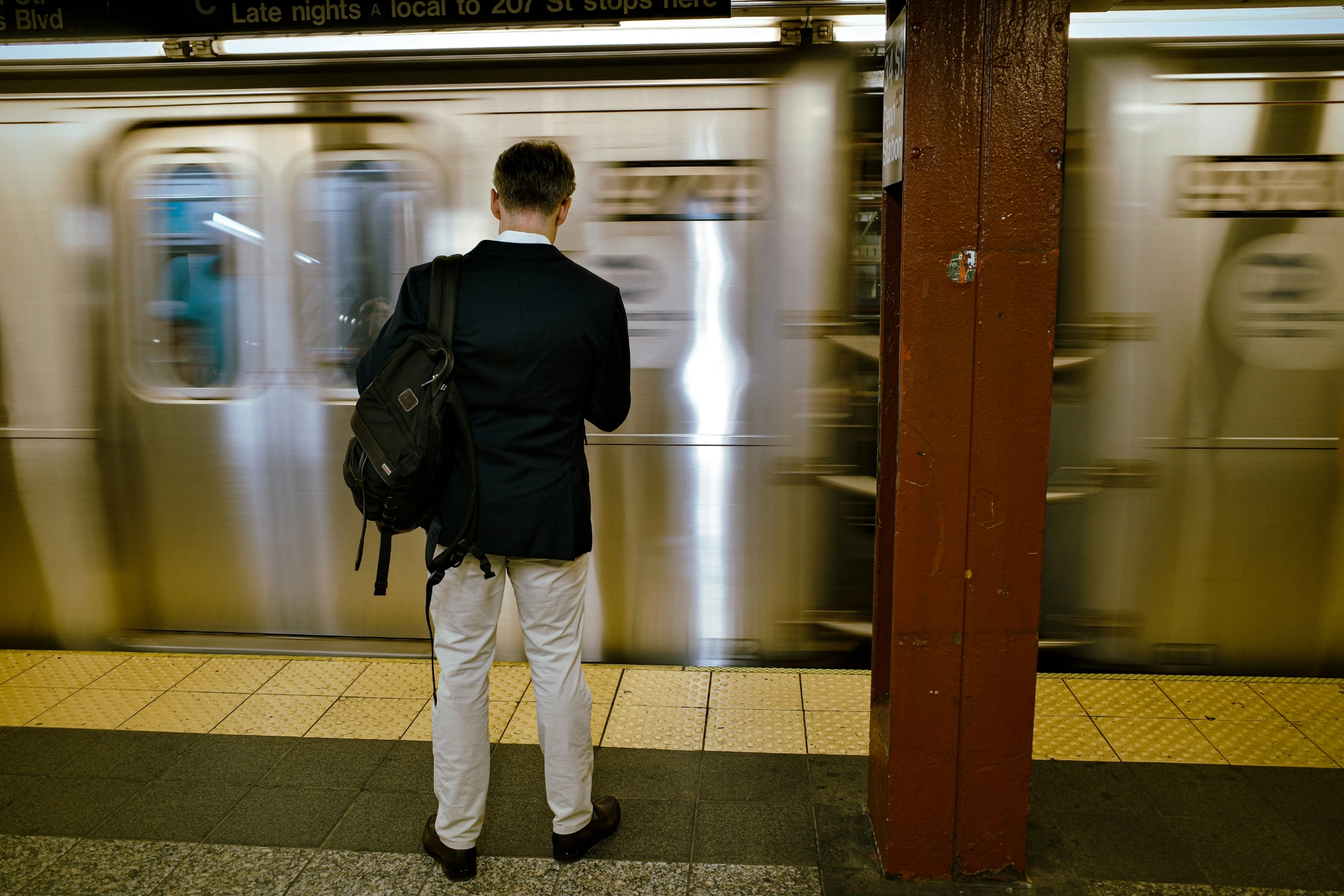
The New York City subway is truly an extraordinary underground world — a city beneath the city, with 472 stations spread across 25 lines, making it the system with the most stations in the world. Inaugurated on October 27, 1904, this incredible infrastructure is one of the oldest, most extensive, and most heavily used transit networks on the planet, operating 24 hours a day, 7 days a week. The numbers speak for themselves: in 2019, it carried nearly 1.7 billion passengers, making it the busiest subway system in the United States.
The Big Apple offers a one-of-a-kind transportation system, and the subway will undoubtedly be your most reliable travel companion as you explore the city. It’s the fastest, most convenient, and most affordable way to move between neighborhoods, letting you experience New York like a true local. With 1,055 kilometers of tracks connecting Manhattan, the Bronx, Brooklyn, and Queens, this vast network may seem daunting at first — but once you unlock its secrets, it becomes the key to discovering every corner of the city that never sleeps.
Mastering the New York subway system is essential to getting the most out of your trip. That’s why at Il Mio Viaggio a New York, we’ve created a complete guide that reveals all the secrets of the subway: from reading the map to the must-know lines for tourists, from how the payment system works to current fares ($3,00), plus practical tips for riding safely and efficiently like a true expert.
Get ready to discover how to navigate the Big Apple with the confidence of a born-and-raised New Yorker, turning every commute into an unforgettable adventure!
Article Contents
- How often will you use the subway in New York during your stay?
- Everything you need to know before boarding the New York subway
- New York subway map: The secret to navigating like a pro is decoding it!
- The Must-Ride Lines for the Perfect Tourist
- Local and express trains: the key to getting around like a true New Yorker
- Paying for the subway: everything you need to know about OMNY
- Mastering transfers: the key to moving around like an expert
- New York subway hours, frequencies, and service changes: mastering the rhythms
- Secrets for Getting Around Like a True New Yorker
- Discover New York Like a True Local: Your Journey in the Big Apple Starts Now
How often will you use the subway in New York during your stay?
It depends a lot on how you’ve organized your trip, but there’s a rule of thumb that holds true for most tourists: you’ll take the subway at least 2–3 times a day. Manhattan is a wonderful city to explore on foot — and we encourage you to do so as much as possible — but the distances between neighborhoods are real. From your Midtown hotel to Coney Island by subway takes 40 minutes; on foot, your day is over before it even begins.
This calculation will help you quickly figure out whether it’s worth getting an OMNY card with loaded credit or relying on the Weekly Fare Cap. If you plan to move around a lot and change neighborhoods frequently, with 12 rides in 7 days you hit the spending cap ($35) and then ride for free for the rest of the week. If you’re in New York for 3–4 days and plan to walk a lot, single-ride fares may be enough. Our recommendation: get an OMNY card and top it up — zero stress, you only pay for what you use.
Everything you need to know before boarding the New York subway
The New York City subway (which locals simply call “the subway”) is a complex but surprisingly logical system once you understand how it works. With 25 currently operational lines and over 470 stations connecting all boroughs except Staten Island, this network will become your master key to exploring every corner of the city the way real New Yorkers do.
Why the subway is the smartest choice for tourists
The subway will be your most valuable travel companion during your New York adventure. It’s the smartest way to get around quickly, comfortably, and without spending a fortune between the different neighborhoods of the Big Apple. Forget buses and taxis: with the subway, you’ll never get stuck in the city’s chaotic street traffic, saving precious time for your explorations.
Here’s a benefit you’ll love: there are no complicated fare zones. With a single ticket, you can travel from the stop closest to your hotel to any destination in the city. The NYC subway is democratic and universal — from Wall Street managers to Brooklyn students, everyone rides it daily because it’s simply the most practical and efficient way to get around.
During your rides, you might come across spontaneous performances by musicians or street artists, turning a simple commute into an authentic moment of New York culture.
How to decode the secrets of the subway
The NYC subway runs nonstop, 24 hours a day, every day of the year — a service that very few cities in the world can guarantee. Keep in mind, however, that during late-night hours and on weekends, some routes may be temporarily modified for maintenance work.
To navigate with confidence, you need to get familiar with these key elements:
- Train frequency: During peak hours (6:30–9:30 AM and 3:30–8:00 PM) you’ll wait at most 2–5 minutes. The rest of the day, the wait stretches to 5–10 minutes, while in the evening and overnight you may wait up to 20 minutes after midnight.
- Finding your direction: Trains heading north show “Uptown/Bronx,” those heading south show “Downtown/Manhattan.” Many stations have separate entrances for each direction, so make sure you pick the right one to avoid backtracking.
- Local vs. Express: Local trains stop at every station; express trains skip some stops to go faster. On the map, white dots indicate where all trains stop, black dots mark local-only stops.
- How to pay: Since 2019, OMNY has made it possible to pay by simply tapping your contactless card or smartphone. The old MetroCard was still usable through 2026.
What happens in the first few days
Don’t worry if you feel a little disoriented in the first couple of days. It’s completely normal to need a few extra minutes to get your bearings — even New Yorkers needed time to learn the ropes.
Residents are always in a hurry and may seem brusque, especially during rush hours. If someone seems impatient behind you, don’t take it personally: it’s just the nature of city life.
Here’s how to prepare:
- Study in advance: Save the subway map on your phone or grab the free paper version available at stations.
- Always plan ahead: Google Maps or the MTA app will give you precise directions and alert you to any delays.
- Avoid the rush at first if possible, especially in your first few days. The frenzy of peak hours can be overwhelming for first-timers.
- Bring a layer in summer: The air conditioning in the cars is extremely powerful and you might get cold during longer rides.
- Ask for help: If you need assistance getting familiar with the city, try our Italian-language concierge service.
After using it three or four times, everything will feel natural and effortless. Give yourself the time you need to adjust, and soon you’ll be moving around New York with the ease of someone who’s lived there for years.
New York subway map: The secret to navigating like a pro is decoding it!
The New York City subway map is much more than a simple navigation tool: it’s the key that unlocks the city. Unlike maps from other major cities, New York’s subway map has unique features that make it as iconic as it is functional for anyone who wants to explore every corner of the Big Apple.
Schematic map vs. geographic map: the 2025 revolution
The Metropolitan Transportation Authority (MTA) made a landmark change in 2025, introducing a new version of the map that radically transformed a design that had remained largely unchanged for decades. The historical version was primarily geographic, closely reflecting the actual layout of the city, while the new version adopts a schematic approach with a cleaner, more simplified layout.
What does this mean in practice? The schematic map uses 45° and 90° angles for its lines, creating a visually more organized system that makes routes far easier to understand. This approach does sacrifice geographic accuracy, but gains in operational clarity. The good news: both versions remain available and are continuously updated by the MTA.
What makes New York’s map unique compared to other world capitals? It shows streets, parks, and neighborhoods alongside the curved subway lines, while cities like London use purely geometric diagrams with straight lines and precise angles.
How to use Google Maps to navigate the New York City Subway
Telling local and express stops apart: the dot system
Mastering the distinction between local and express trains is a fundamental skill, clearly coded on the map through a precise symbol system:
- Black dots identify stations served exclusively by local trains, which stop at every single station.
- White dots mark stations served by express trains, designed to skip intermediate stops for faster travel.
The updated map introduces a revolutionary feature: each train now has its own color-coded line segment that follows it along its entire route. This system lets you instantly identify the path of each individual train and immediately see whether it stops or skips a given station. This is the most valuable change for first-time subway riders, dramatically reducing the risk of route errors.
Additionally, each subway line has a distinctive color paired with a specific number or letter. Characters in bold indicate a full seven-day-a-week service, while those in regular format signal limited or weekday-only service.
Getting the updated map: all available options
To always have the latest version at your fingertips, you have several options:
- Digital format: Download the PDF map for free from the official MTA website.
- Specialized apps: Since 2012, “The Weekender” has been available (initially for iOS, later extended to Android), showing information about scheduled weekend maintenance work.
- Physical copy: Available for free at subway stations.
Since 2023, the MTA has launched a “live” map developed by Work & Co, which shows train positions, delays, weekend closures, and ongoing works in real time. Its unique feature? It intelligently combines both approaches: when zoomed out, it shows the schematic design; when zoomed in, it blends with the actual geographic reality of the city.
Always remember that the map prioritizes functional clarity over geographic accuracy: its purpose is to show you lines, stations, and transfer points in the clearest possible way, turning your subway experience into a stress-free journey.
The Must-Ride Lines for the Perfect Tourist
The Big Apple offers an incredible network of 25 subway lines, but to truly experience the city like a protagonist, you’ll focus on just a few strategic groups. With its 1,055 kilometers of track winding through the city, this vast network might seem complex — but we know exactly which lines will turn your daily commutes into effortless trips between the most spectacular attractions. If you want to learn even more, don’t miss Piero Armenti’s book “New York metro per metro,” full of anecdotes and curiosities.
The Legendary Reds: 1, 2, 3
The red lines are undoubtedly the backbone of the New York tourist experience, running through Manhattan from north to south along the West Side. These “IRT Broadway–Seventh Avenue” lines will take you through breathtaking urban scenery and iconic neighborhoods.
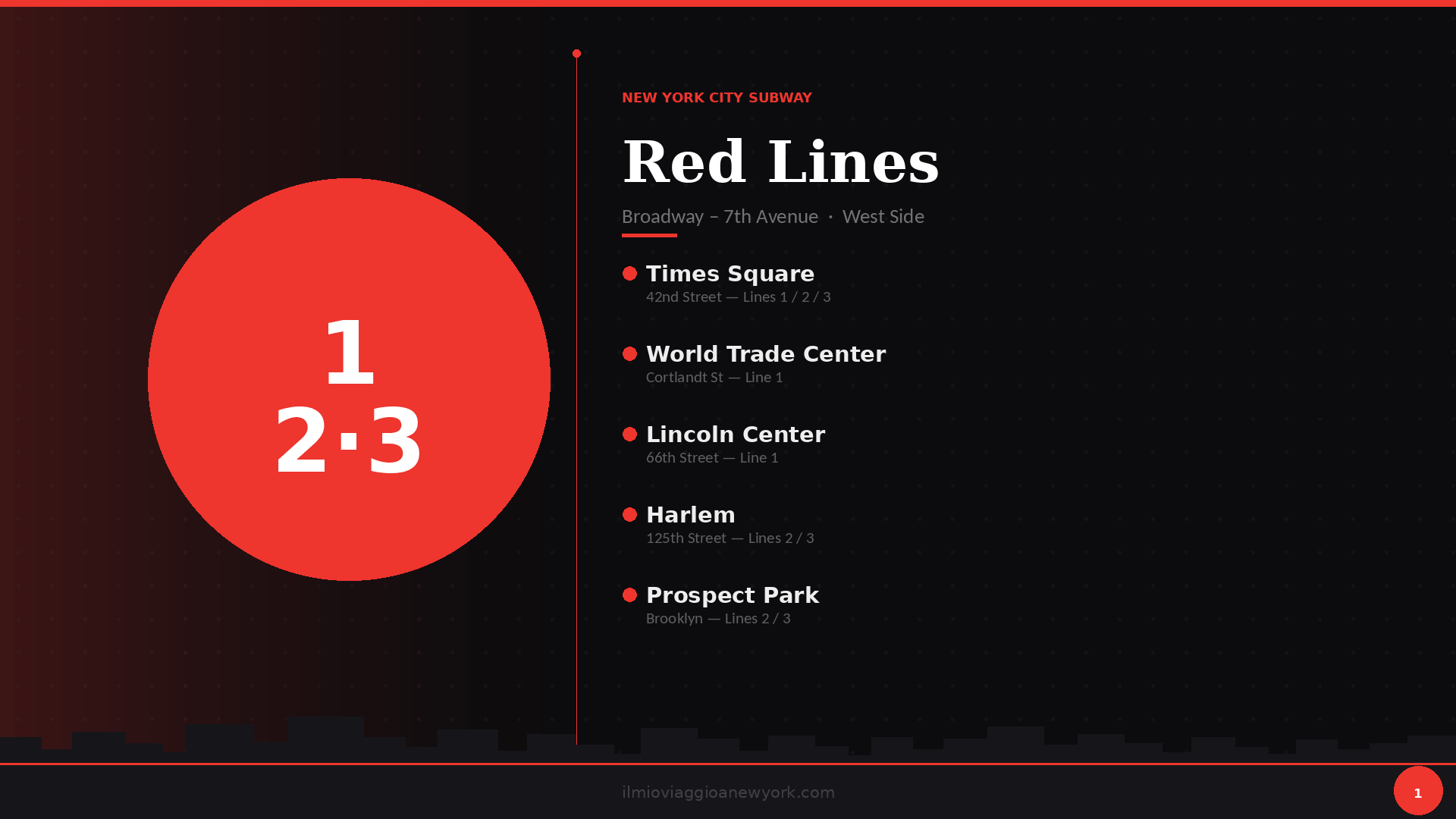
Line 1 is your reliable local train, stopping at every station. It starts at Battery Park and runs majestically along 7th Avenue, passing through the electrifying Times Square and continuing north to the prestigious Columbia University. It’s the ideal option to reach Times Square, Lincoln Center, or head south to the historic World Trade Center.
Lines 2 and 3 are your fast express options, perfect when you want to save time and skip intermediate stops. They share the route with Line 1 but branch off to unique destinations: north to authentic Harlem, south through Brooklyn with strategic stops near Prospect Park and the Brooklyn Museum.
The Upper East Side Greens: 4, 5, 6
The green lines dominate the eastern part of Manhattan along Lexington and Park Avenues, identifiable by their distinctive green color associated with the “IRT Lexington Avenue” line. These are your keys to the city’s most elegant neighborhoods.
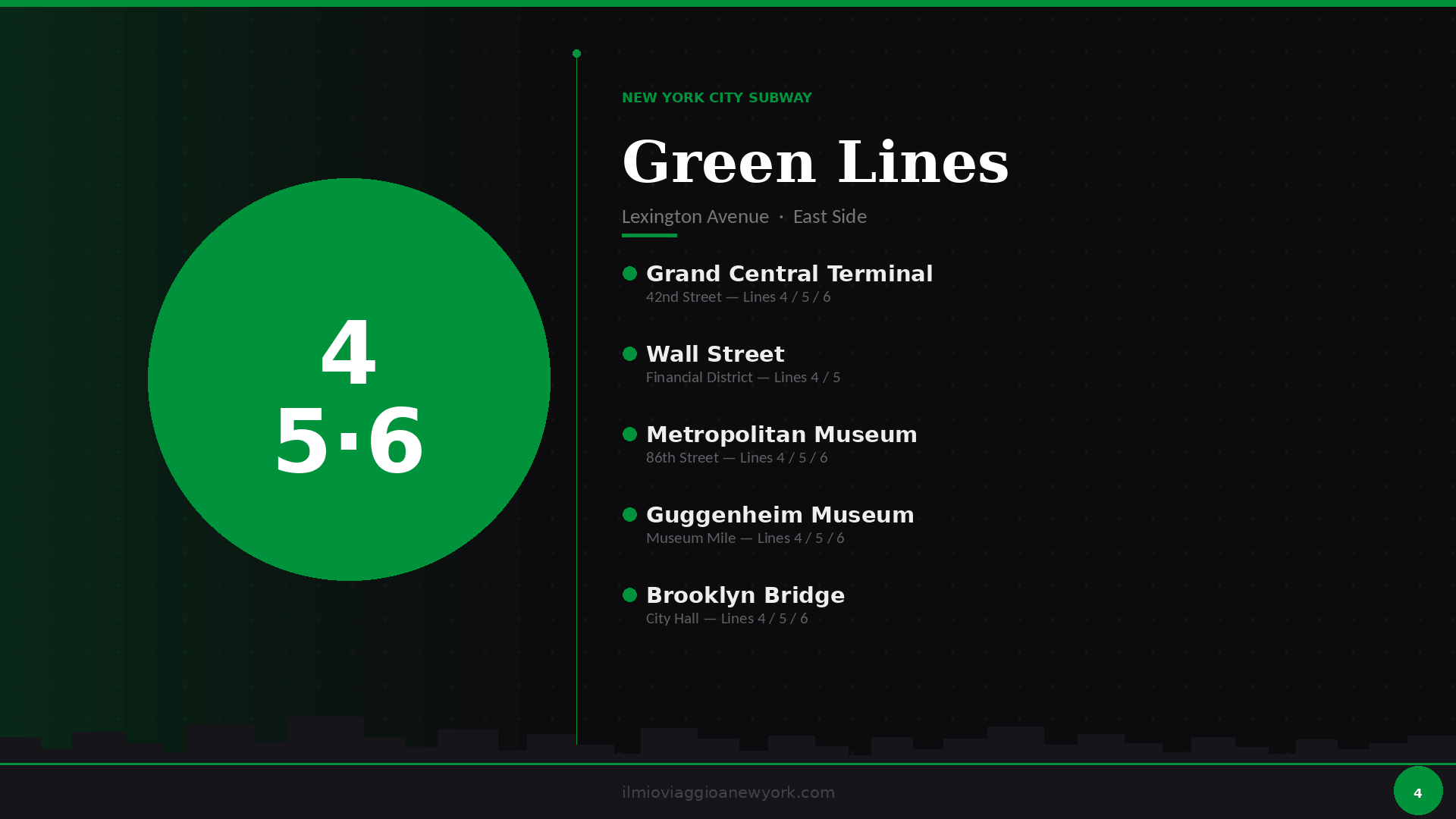
Line 4 (Lexington Avenue Express) offers a spectacular connection between the Bronx and Brooklyn, from Woodlawn to Crown Heights–Utica Avenue. During the main part of the day (5:30 AM–8:30 PM), it provides local service in the Bronx and express service in Manhattan and Brooklyn, covering 28 stations in approximately 1 hour and 10 minutes.
Line 5 shares a strategic route with Line 4, perfect for exploring iconic attractions such as Grand Central Terminal, Union Square, and the Wall Street financial district.
Line 6 (Lexington Avenue Local / Pelham Local) is the most reliable 24-hour service, stopping at all stations from Pelham Bay Park to Brooklyn Bridge–City Hall. During standard hours it covers 38 stations in approximately 1 hour and 5 minutes.
These lines are the exclusive gateway to the Upper East Side, letting you easily reach cultural gems like the Guggenheim and the Metropolitan Museum of Art.
The Blues and Oranges: A, C, E, B, D, F, M
The blue lines (A, C, E) offer stunning scenery along 8th Avenue, passing alongside Central Park with a stop at the famous Columbus Circle. Their blue color identifies the “IND Eighth Avenue” — one of the most scenic routes in the system.
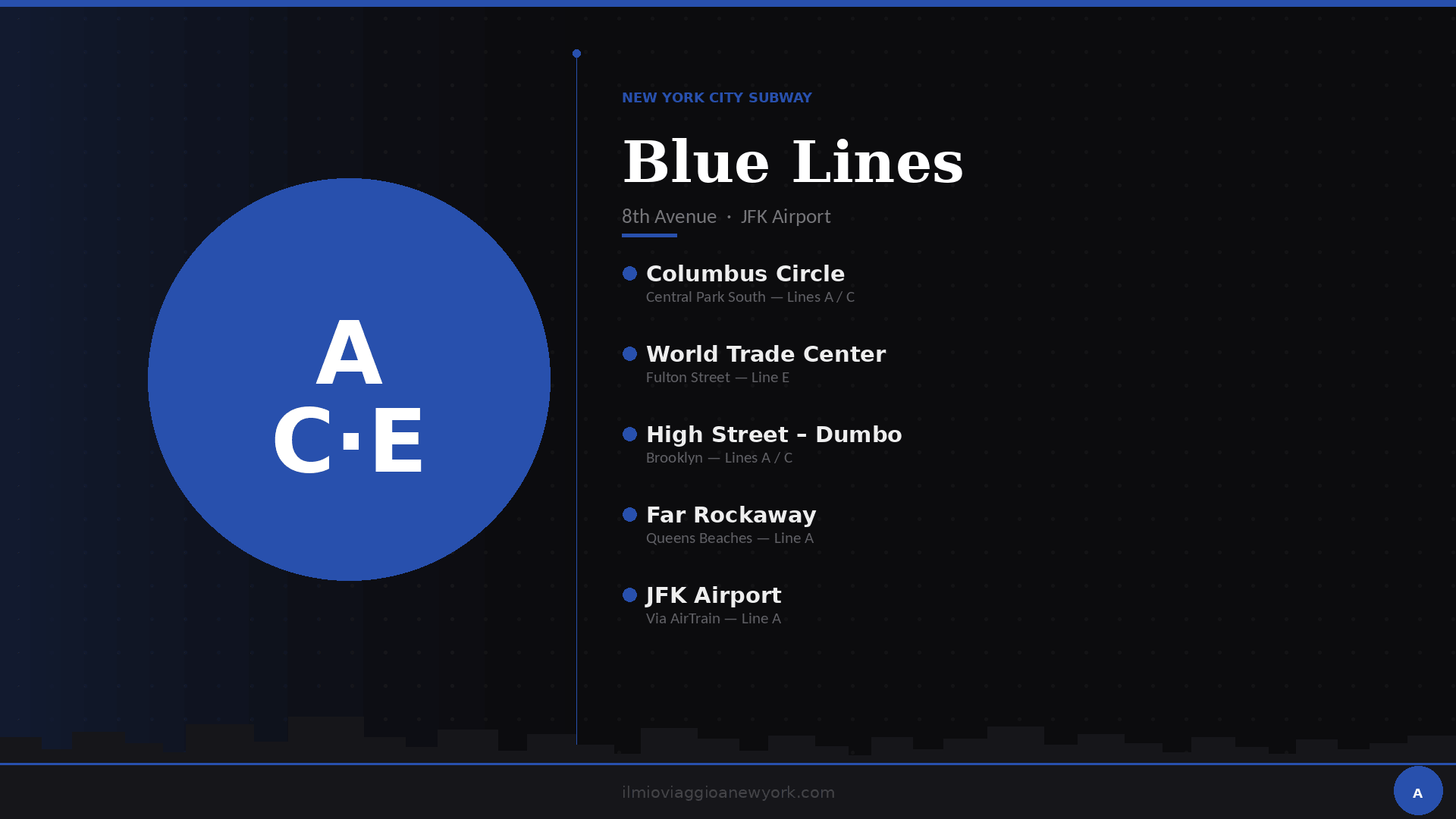
The A Express runs from 207 St in Manhattan to destinations in Queens: Lefferts Blvd, Far Rockaway, and Rockaway Park. The C Local elegantly connects 168 St in Manhattan with Euclid Av in Brooklyn. The E deserves special mention: it’s the only line that takes you directly to the World Trade Center, linking Jamaica Center in Queens with the heart of Manhattan’s financial district.
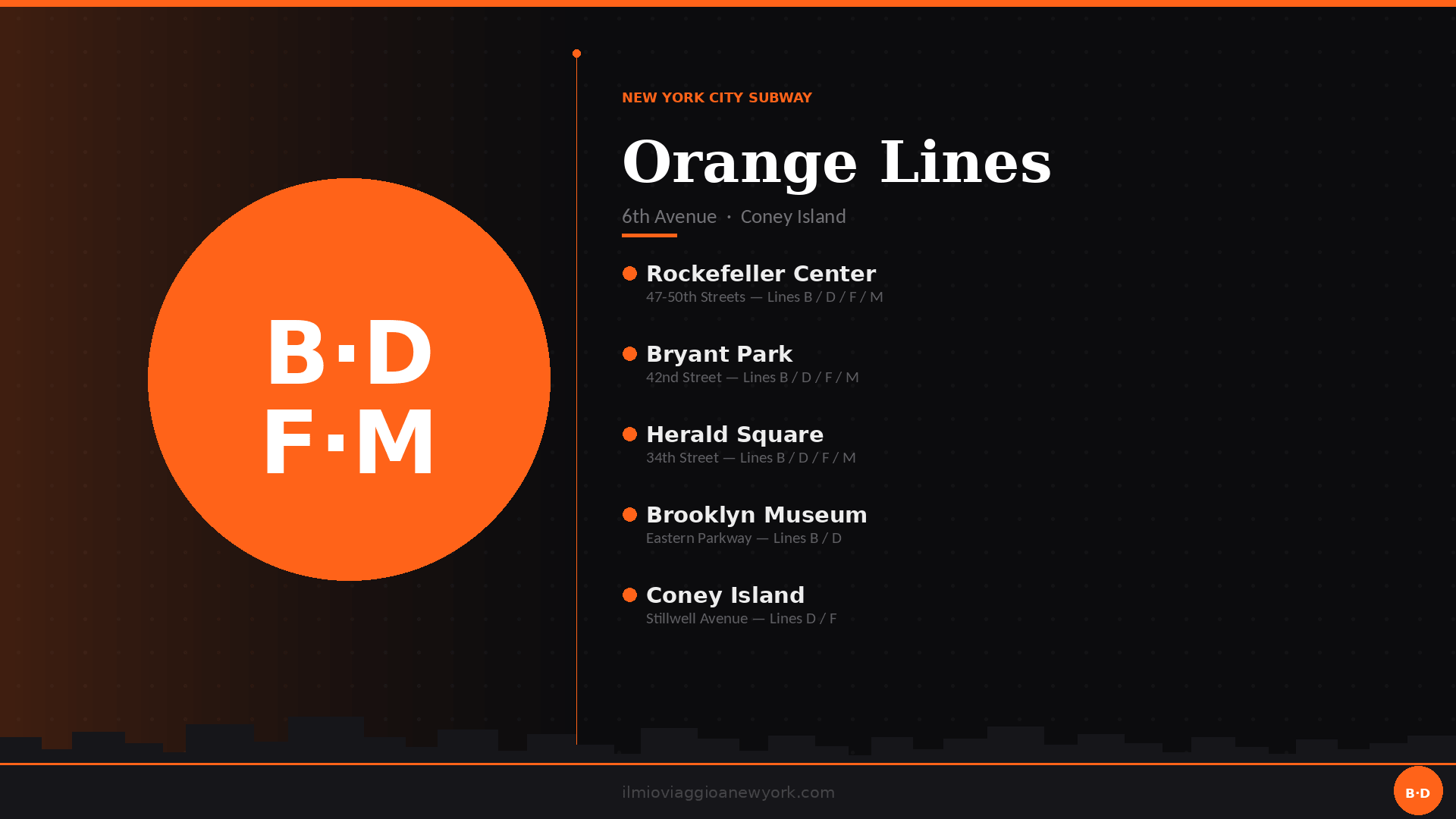
The orange lines (B, D, F, M) follow the “IND Sixth Avenue” and are popular with tourists for the numerous attractions they pass through. The B Express runs exclusively on weekdays, connecting Jamaica–179 St to Stillwell Av. The D Express crosses three boroughs from 205 St in the Bronx to Stillwell Av in Brooklyn. The F offers both local and express service from Jamaica–179 St to Stillwell Av, and is a must if you want the unique experience of Coney Island. The M Local rounds out the group, connecting Forest Hills–71 Av to Middle Village–Metropolitan Av in Queens.
Always double-check the train number or letter before boarding: different lines often run on the same track, and this simple habit will ensure smooth, hassle-free travel.
Local and express trains: the key to getting around like a true New Yorker
Mastering the difference between local and express trains is the secret to moving around the Big Apple with the efficiency of a local. We know this aspect can be confusing at first, but once you understand it, you’ll be able to optimize every journey and save precious time during your New York adventure.
Recognizing stations: the signs you can’t miss
Avoiding the frustration of watching your stop fly past is easier than you think. Here are the most reliable methods:
The subway map tells you everything through a system of colored dots. Black dots mark stops exclusive to local trains; white dots indicate stations served by both local and express trains. This remains the most reliable method for planning your route without surprises.
Inside stations, the lit display boards on the platforms are your best allies, clearly specifying whether the next train is local or express. Audio announcements provide the same information, though the New York accent may take a little getting used to.
On the trains themselves, you’ll always find clear markings: “EXP” or “Express” for express trains, “LCL” or “Local” for locals. A useful rule of thumb: local trains generally use the inner tracks, while express trains use the outer tracks.
When the express makes all the difference
Express trains prove their worth when covering long distances, especially across Manhattan. Traveling the island from north to south can take up to 30 minutes on a local, while an express often takes 15 minutes or less.
The winning strategy? Use the express to cover long stretches quickly, then switch to a local to reach your final destination. This approach is especially effective during rush hours, when every minute counts.
One important caveat: after 10:30 PM, many express trains operate as locals, stopping at all stations. On weekends, service changes are frequent, so always check for the latest updates before you set out.
If you board the wrong train: don’t panic
Even the most seasoned New Yorkers occasionally get on the wrong train. The most straightforward solution is to get off at the next available stop and take a train in the opposite direction, making sure this time it’s the right type.
Alternatively, you can rethink your route: continuing on the express to a major transfer hub and switching there can be more efficient than backtracking. This works particularly well when your destination is reachable via multiple lines.
With an unlimited MetroCard or OMNY, transfers don’t cost anything extra. If you’re paying single fares, remember the 18-minute rule: you must wait at least 18 minutes before tapping the same payment method again at the same turnstile, or you’ll be charged another $3.00.
Mistakes are part of the learning process. With a few days of practice, telling locals from expresses apart will become second nature, letting you navigate the city with the confidence of someone who truly knows it. You might also consider purchasing our New York map service, which helps tourists orient themselves and reach their desired attractions while saving time.
Paying for the subway: everything you need to know about OMNY
Getting around the Big Apple requires a solid understanding of the subway’s payment system. Since January 1, 2026, the city has completed its transition to the OMNY (One Metro New York) system, making the old MetroCard — which accompanied tourists and residents for decades — obsolete.
How much does a New York City subway ride cost?
A single subway ride costs $3.00. This fare lets you use both the subway and local buses at no extra charge. Express buses have a higher fare: $7.25.
Those eligible for reduced fares (seniors or people with disabilities) pay exactly half: $1.50 for subway and local bus rides. Children under 44 inches (111.76 cm) ride free, up to a maximum of three children per paying adult.
Here’s a quick breakdown of what you’ll pay:
| Payment Method | Cost per ride |
|---|---|
| Carta contactless / Apple Pay / Google Pay (direct) | $3,00 |
| OMNY Card with preloaded credit | $3,00 |
| Single Ride Ticket from Vending Machine | $3,50 |
| Express Bus | $7,25 |
| After 12 rides in 7 consecutive days | Free |
| Children under 112 cm (max 3 per adult) | Free |
| Seniors and people with disabilities | $1,50 |
The detail many people don’t know: if you tap your credit card or phone directly on the reader, you’re charged the full fare of $3.50. If you use a physical OMNY card with preloaded credit, the price drops to $3.00 per ride. Over a week-long stay, the difference adds up.
OMNY: the solution that simplifies everything
The OMNY system has eliminated the lines at ticket machines and made payment instant. You no longer need to plan ahead how many tickets to buy or worry about reloading a card. Simply tap the reader with:
- Your contactless credit or debit card
- Your smartphone with a digital wallet (Apple Pay or Google Pay)
- Your payment-enabled smartwatch
- A physical OMNY card
When the payment goes through, the display shows “GO” on a green background. An important benefit: if you transfer to another service within two hours, the transfer is free — just like it was with the MetroCard. The only condition is that you always use the same payment method; otherwise, you’ll be charged another $3.00.
Physical OMNY card: when it might come in handy
Even though paying with a smartphone or contactless card is more convenient, there are situations where a physical OMNY card can be advantageous.
If you’re traveling in a group, you can pay for up to four passengers with a single card. Keep in mind, however, that only the first passenger will benefit from the weekly fare cap. If you prefer to pay in cash, the OMNY card can be purchased and topped up at over 2,000 retail locations throughout the city.
The card costs $2 and lasts up to five years — more than double the lifespan of the old MetroCard. An investment that pays off quickly.
The automatic fare cap that saves you money
One of OMNY’s smartest innovations is the Weekly Fare Cap: a subscription that activates automatically. After 12 rides in 7 consecutive days ($35 total), all subsequent rides that week become free.
You don’t need to decide in advance whether it’s worth it: you pay only for the rides taken until you hit the cap. Since 2023, the 7-day window starts from your first trip — it no longer follows the calendar week. Remember to always use the same payment method: switching between a physical card and a digital wallet prevents the system from recognizing your rides as belonging to the same user.
By registering on the OMNY website with your usual card, you can track your rides and view up to one year of travel history.
Mastering transfers: the key to moving around like an expert
Knowing how to change lines with ease is one of the most valuable skills for exploring New York efficiently. The vast subway network offers numerous transfer stations connecting multiple lines simultaneously, allowing you to switch from one line to another without ever leaving the underground system.
Indoor transfers: everything stays simple
Transfer stations allow you to get off one train and board another while keeping your fare valid. On newer trains, displays clearly show upcoming stops along with the numbers or letters of the available connecting lines. Audio announcements also always communicate possible connections before reaching the next station.
Keep in mind that these stations are often large and complex: walking for several minutes during transfers between different lines is completely normal. At major Manhattan stations like Times Square, you may need to walk through considerable corridors. However, following the signs calmly will save you precious time and help you avoid directional mistakes that could complicate your journey.
Street-level transfers: when you need to exit
Some situations require you to exit the subway and walk briefly above ground to reach another transfer station. These “street transfers” are less common than indoor transfers but equally functional.
The good news? Even when you exit through the turnstiles, the transfer remains free. With OMNY, you have a 2-hour window to change between subway and bus services at no extra cost. The key is always using the same payment method to take advantage of this benefit.
Be careful if you’re still using an unlimited MetroCard: you’ll need to wait 18 minutes between entries after exiting and re-entering, otherwise you’ll need to purchase a single-ride ticket.
AirTrain JFK: il collegamento diretto dall’aeroporto alla subway che tutti dovrebbero conoscere
Atterri al JFK e vuoi raggiungere Manhattan senza spendere una fortuna né perdere tempo nel traffico? L’AirTrain è la soluzione perfetta e super affidabile: un treno automatico gratuito tra i terminal che in pochi minuti ti porta alle stazioni di Jamaica (linee E, J, Z verso Midtown e Brooklyn) o Howard Beach (linea A verso Lower Manhattan e Brooklyn).
Il costo del collegamento è di soli 8,75 $ (tariffa 2026) e si paga comodamente all’uscita toccando la tua OMNY o carta contactless alle porte di Jamaica o Howard Beach. In 10-15 minuti sei già sulla metropolitana e in meno di un’ora arrivi in centro: più economico e veloce del taxi, senza sorprese. È il modo che usano i newyorkesi doc e che ti permette di partire subito alla scoperta della Grande Mela con il sorriso!
Decoding the map symbols for transfers
The subway map identifies line-change options through a specific legend that’s worth knowing. When you see multiple trains of the same color listed at a stop, you can always transfer between them while remaining inside the station.
Transfers between different lines have distinct representations:
- Lines grouped together or connected by a solid black dash indicate an indoor station transfer.
- A dashed black line with a walking-person icon signals that the two stations are not connected underground (street transfer).
- A special case is the Times Square–42 St station, where the connection to 42 St–Bryant Park is limited to specific hours, represented by a dashed black line interrupted by a circle with a star.
Mastering these symbols will allow you to plan your journeys with precision, especially when you need to switch between different lines to reach your destination.
New York subway hours, frequencies, and service changes: mastering the rhythms
Navigating the New York subway with confidence means knowing the rhythms and frequencies of this extraordinary system inside and out. The Big Apple’s subway runs 24 hours a day, but with significant variations that can make the difference between a perfect trip and a few too many unexpected hiccups.
Rush hours and late-night service
Weekday rush hours in New York fall between 7:30–9:30 AM and 4:30–6:30 PM, when the city pulses at full energy. During these peak windows, trains run with remarkable frequency — approximately every 2–5 minutes on major lines. The daytime off-peak period offers a slightly more relaxed service, with waits of 10 to 15 minutes.
Late-night service operates on completely different dynamics. After midnight, frequency drops considerably and you may wait up to 20 minutes for a train, especially on secondary lines. One crucial point to remember: after 10:30 PM, express trains often run as locals, stopping at all stations.
Weekends and the nighttime map: when everything changes
The night brings significant modifications to subway service. Some lines are not operational or run completely different routes. To help you navigate, the MTA has created a dedicated nighttime map — recognizable by its characteristic black background — that shows exactly which lines are running and how.
Weekends represent the most complex challenge for every traveler. Necessary maintenance work often leads to temporary service changes: suspended sections, rerouted trains, or lines operating as shuttles on reduced routes. The scheduled changes for lines 4 and 5 in the coming months are particularly noteworthy.
Winning strategies to avoid delays
We know how frustrating it can be to find yourself unprepared when service changes occur unexpectedly. That’s why you should always check alerts before heading out, especially at night or on weekends. The MTA communicates these changes through multiple channels:
- Flyers posted in stations and on trains
- The official website and Twitter account
- Apps like KickMap or the official MTA app, which provide real-time updates
If you have a time-sensitive commitment, the winning strategy is to leave early, factoring in wait times, any line changes, and actual travel time — roughly 4 minutes between stops. This planning will ensure you move around the city that never sleeps without ever missing a beat!
Secrets for Getting Around Like a True New Yorker
Transforming yourself from a disoriented tourist into a subway expert requires knowing a few golden rules that only those who truly live in the Big Apple know. We understand how important it is to master these secrets in order to have an authentic, hassle-free experience in the heart of the metropolis.
The mistakes that give you away as a tourist
The first rule for moving comfortably on the New York subway is to respect the city’s relentless flow. Never stop suddenly on the platform or in front of turnstiles: New Yorkers operate at a pace unlike anywhere else in the world, and every second matters! The left side of escalators is sacred and reserved exclusively for people moving quickly up or down — always keep to the right.
Paying attention to the direction of the train is crucial to avoid ending up on the opposite side of the city: confusing “uptown” (north) with “downtown” (south) is the classic mistake that immediately reveals you’re a tourist. Subway exits must always be kept clear — this is an unwritten but ironclad rule that everyone respects religiously.
The art of riding in crowded cars
Living the authentic subway experience also means knowing how to share space with millions of people who pass through this incredible underground network every day. In crowded cars, mutual respect becomes essential: never take up two seats with your bag, don’t put your feet on the seats, and don’t “monopolize” the center pole by preventing other passengers from holding on.
Giving up your seat to elderly, disabled, or pregnant people is not just good manners — it represents the true New York spirit of urban solidarity. Always use headphones for music and avoid strong-smelling food that could disturb fellow travelers. A true local’s tip: always take your backpack off your shoulders in a packed car to avoid accidentally hitting other passengers — this gesture will immediately mark you as someone who truly knows the subway’s unspoken rules.
Safety and peace of mind on the subway
The New York City subway has reached remarkable levels of safety: 2025 data shows a 21% drop in crime compared to the monthly average in 2024. Every car is equipped with surveillance cameras, and security patrols have been significantly increased.
Despite these exceptional improvements, staying alert is always the key to enjoying every ride with peace of mind. During late-night hours, traveling in a group is always preferable, and at less-frequented stations, look for the well-lit Off-Hour Waiting Areas, which are constantly monitored by officers or security cameras.
The final tip from a true expert: don’t display valuables and always keep your personal belongings in check. By following these simple but fundamental precautions, you’ll ride the subway like an authentic New Yorker, turning every trip into a safe and unforgettable experience.
After 10:30 PM, seriously consider taking a taxi or an Uber. It’s not a safety issue — New York is a safe city, and the data confirms it. It’s a matter of comfort and logistics. At night, trains slow down, expresses become locals, some lines reroute, and waits at less-frequented stations can stretch to 20 minutes. If you’re in Midtown or downtown with tired legs after an evening on Broadway, an Uber won’t break the bank and gets you home in ten minutes. Use the subway at night for short, well-connected trips; for everything else, a taxi is the smart choice.
Discover New York Like a True Local: Your Journey in the Big Apple Starts Now
The New York City subway is far more than a simple transportation system: it’s the key that opens the doors to every corner of this breathtaking metropolis. Through this complete guide, you’ve gained the essential tools to master the subway like an authentic New Yorker — from reading maps to the secrets of local and express trains, from the OMNY system to strategies for seamless transfers.
We know that the first encounters with this underground labyrinth can feel challenging, but you now have everything you need to turn every journey into a smooth, efficient experience. This extraordinary network, running nonstop 365 days a year, gives you direct access to the city’s most coveted attractions, helping you avoid the surface traffic chaos and make the most of every moment of your adventure.
The experience that awaits you goes far beyond simply getting from point A to B: it will become an integral part of your journey in the city that never sleeps. Every ride will immerse you in the pulsating energy of New York — street artists, authentic New Yorkers, and that unique atmosphere that only the Big Apple can deliver.
The time has come to put everything you’ve learned into practice: download the MTA app on your smartphone right now, set up your contactless payment method, and get ready to explore Manhattan, Brooklyn, Queens, and the Bronx with the confidence of someone who truly knows the secrets of the subway. The city awaits you to take you on an unforgettable journey — and don’t forget to book your New York City tour in Italian with our expert guides! Now you have everything you need to experience the city like a true protagonist!
FAQ
A single ride costs $3.00 if you pay directly with a contactless card or smartphone. If you use a physical OMNY card with preloaded credit, the price drops to $3.00. Children under 44 inches ride free (up to 3 per paying adult). Seniors and people with disabilities pay $1.50.
How do you pay for the subway in New York in 2026? As of January 2026, the official system is OMNY. You can pay by tapping a contactless credit/debit card, your smartphone (Apple Pay, Google Pay), a payment-enabled smartwatch, or a physical OMNY card. The old MetroCard no longer exists: if you have one from a previous trip, it’s no longer usable.
Where can you buy the OMNY card? You can buy it at ticket machines in all stations, paying with either cash or card. The physical card costs $2 and lasts up to 5 years. If you want to skip the machine lines upon arrival, you can purchase it in advance on our website before you leave.
Yes, but it activates automatically — no need to purchase it in advance. After 12 rides in 7 consecutive days (totaling $35), all subsequent rides that week become free. The 7-day window starts from your first ride, not from Monday. For it to work properly, always use the same payment method.
No, the New York City subway does not offer a daily pass. The only time-based option is the Weekly Fare Cap. For those staying just a few days and taking few rides, paying per single ride with the OMNY card is the better option.
The Brooklyn Bridge does not have a direct subway stop on the bridge itself — you can only cross it on foot or by bike. To get to Brooklyn, the closest option is the 4/5/6 line at Brooklyn Bridge–City Hall on the Manhattan side, or the A/C line at High Street on the Brooklyn side. If you want to walk the bridge and then explore Dumbo, get off at High Street and walk to the bridge in just a few minutes.
Yes, the subway is open 24 hours a day, 365 days a year — one of the few major cities in the world to guarantee this service. At night, however, trains run every 15–20 minutes, some express trains become locals, and certain routes are modified for maintenance work. For late-night trips after 10:30 PM — especially alone or heading to less central areas — we recommend considering a taxi or Uber.
Don’t panic — it happens to seasoned New Yorkers too. Get off at the next available stop and take a train in the opposite direction. If you’re using OMNY or an unlimited card, the transfer is free. If you’re paying per ride, remember the 18-minute rule: you must wait at least 18 minutes before tapping the same payment method at the same turnstile, otherwise you’ll be charged another $3.00.