
If you’ve decided to visit New York and want to know which are the main attractions to see, you’re in the right place. Planning an itinerary in such a vast metropolis can feel like a daunting task: the options are endless, and the risk of wasting precious time is always around the corner. That’s exactly why Il Mio Viaggio a New York is the perfect guide to show you the truly unmissable spots. Our experience as tour operators and city experts allows us to guide you step by step through the city that never sleeps.
Our goal is to make your adventure simple and unforgettable. Beyond selecting the very best the city has to offer, we provide full support through our dedicated travel services—from detailed maps highlighting New York’s top attractions to a range of exclusive passes and tickets designed to make access easy, let you skip the lines, and help you make the most of every minute of your stay.
In this article, we’ve selected the 12 places you absolutely can’t miss to make your trip to New York truly special.
1. Central Park
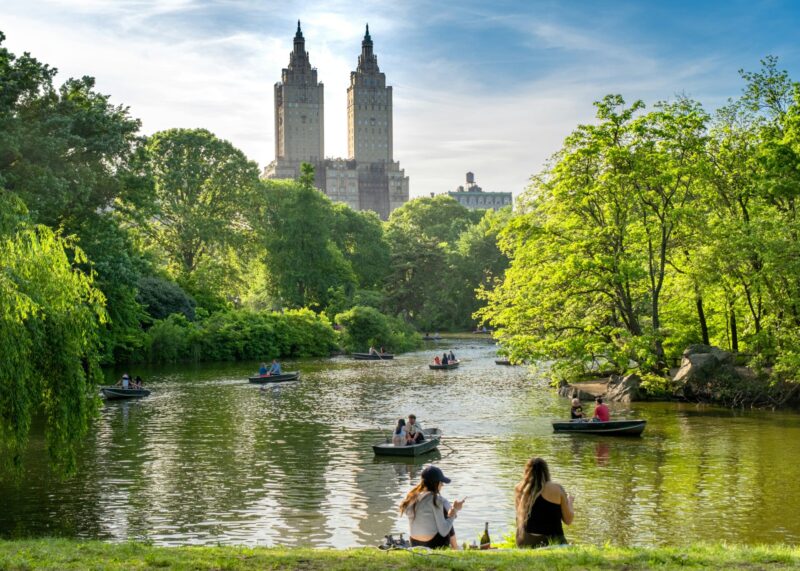
Manhattan’s green lung stretches across an impressive 340 hectares between 59th and 110th Streets, offering a natural oasis in the bustling heart of the metropolis. Central Park is a must-see stop for anyone exploring what to see in New York, a true microcosm of landscapes, stories, and surprises that deserves an in-depth visit.
Built between 1857 and 1876, Central Park is an extraordinary engineering achievement that required the work of over 20,000 laborers and the relocation of millions of cubic meters of earth and rock to create paths and artificial landscapes that today appear almost natural. Its construction also involved the forced clearance and demolition of several settlements, including Seneca Village.
Central Park: what to see
Inside the park, there are numerous spots you can visit. If you’re a music lover and a Beatles fan, we recommend the memorial dedicated to John Lennon.
Strawberry Fields is a 10,000-square-meter area named after the song “Strawberry Fields Forever.” At its center is a black-and-white mosaic inscribed with the word “Imagine,” crafted by Neapolitan artisans and gifted to the City of New York. Nearby stands the Dakota Building, the residence where Lennon lived with Yoko Ono until his assassination, which took place right in front of the building’s entrance.
Another point of interest is Belvedere Castle, a unique attraction designed by Frederick Law Olmsted, which has housed the official weather station since 1919. From its tower, you can enjoy panoramic views and go birdwatching.
Bethesda Terrace and Fountain form the heart of the park with its fountain, one of the largest in New York and among the most famous in the world. At its center stands the neoclassical sculpture Angels of the Water, the only piece commissioned in the original design.
Other must-see spots include Bow Bridge, a cast-iron bridge that spans 18 meters over an artificial pond, and The Mall, a beautiful tree-lined avenue featuring over 150 American elms. In other articles, we’ve also covered the Blockhouse fort and other attractions to see within Central Park.
Central Park: recommended experiences
The best way to explore is by renting a bike in Central Park, which will allow you to see many attractions in just a few hours. If you’re feeling romantic, you can also opt for a boat ride at The Loeb Boathouse, overlooking the lake.
For a different experience, you can choose to attend a show at the Swedish Cottage Marionette Theatre, a small house imported from Sweden in 1876 that now hosts a puppet theater. Here you can find the showtimes. If you’re traveling with family, don’t miss the Central Park Zoo, home to over 130 different species, including coyotes, raccoons, and foxes. Be sure to see the rare snowy owl and the local birdlife symbol: Pale Male, the hawk.
In winter, the park offers the opportunity to ice skate at Wollman Rink, a city icon featured in numerous films such as Home Alone 2: Lost in New York (1992) (here’s our article on the other filming locations), Love Story (1970), Night at the Museum (2006), Limitless (2011), and Mr. Popper’s Penguins (2011).
Central Park: hours and access
The park is open every day from 6:00 AM to 1:00 AM. Access is free, except for certain attractions like the Zoo. The best times to visit are early in the morning, when it’s less crowded, or late in the afternoon to enjoy the best lighting.
To reach the park, the most convenient subway stops are along various streets: on the west side, you can take the B and C lines (72nd St, 81st St, 86th St), while on the east side, the N, R, and Q lines stop at the corner of 5th Ave and 59th St. For more information, check out our in-depth guide on how the subway works in New York.
Following a complete itinerary, a tour of the park can take around 4–5 hours, so it’s recommended to plan your visit by dedicating at least half a day to this wonderful green oasis.
2. Statue of Liberty and Ellis Island
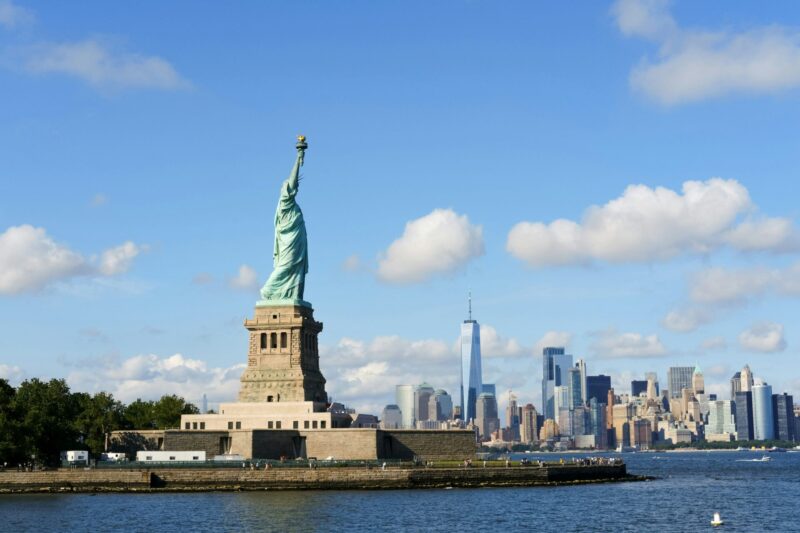
Imagine yourself on a boat drifting away from the chaos of Manhattan: the air grows cooler, and little by little, the Statue of Liberty stops being the tiny figure you see from Battery Park and becomes a towering copper giant looming over you. A symbol of hope and freedom, the Statue of Liberty welcomed migrants arriving in the New World, while Ellis Island represented the final bureaucratic hurdle before setting foot on American soil. These two landmarks are must-see stops in New York, rich in history and meaning.
Statue of Liberty: how to get there
To reach Liberty Island, where the majestic statue stands, the only way is to board the official Statue City Cruises ferries, which depart from Battery Park in Manhattan or from Liberty State Park in New Jersey. Ferries run daily from 8:30 AM to 3:30 PM, with departures every 20–30 minutes. To skip the ticket line, you can purchase Statue of Liberty & Ellis Island tickets directly on our website. To get to Battery Park, you can take the subway: lines 4 and 5 (Bowling Green stop), line R (Whitehall Street stop), or line 1 (South Ferry stop).
The ferry ride takes about 15 minutes and offers the perfect opportunity to admire Manhattan’s skyline from the Hudson River. Plan at least half a day to visit both islands, especially if you want to explore the Ellis Island museum in depth and spend a few hours experiencing a place steeped in stories of hope and fear.
Ellis Island: what to see
Ellis Island is home to the moving Immigration Museum, located in the main building that once served as a registration center for migrants. Inside, you can explore stories, documents, photographs, and personal belongings of the 12 million immigrants who passed through between 1892 and 1954. Italians were the largest national group, with an estimated 4 million arrivals, peaking between 1900 and 1915. If you have a great-grandfather who left for America many years ago, he most likely passed through here.
Particularly moving is the Peopling of America Center, a permanent exhibit that tells the story of American immigration from Native Americans to the present day. Also not to be missed is the American Family Immigration History Center, where you can search a database of all the passengers who arrived on the island to look for possible ancestors.
Outside, you’ll find the American Immigrant Wall of Honor, a wall engraved with over 700,000 names celebrating the contributions of immigrants to American history.
Statue of Liberty: useful tips
The standard ticket to visit both islands costs $33 for adults and $19 for children aged 4 to 12. It includes the ferry ride, island access, and a multilingual audio guide. The price does not include access to the statue’s crown or pedestal.
To avoid long lines, it’s highly recommended to book online before your trip. At boarding, be prepared for strict security checks similar to those at airports. The best time to visit is early in the morning, when it’s less crowded, especially during the busy summer season.
If you’re short on time, a free alternative is the Staten Island Ferry, which passes close to the statue without stopping, still giving you the chance to take photos.
3. Empire State Building
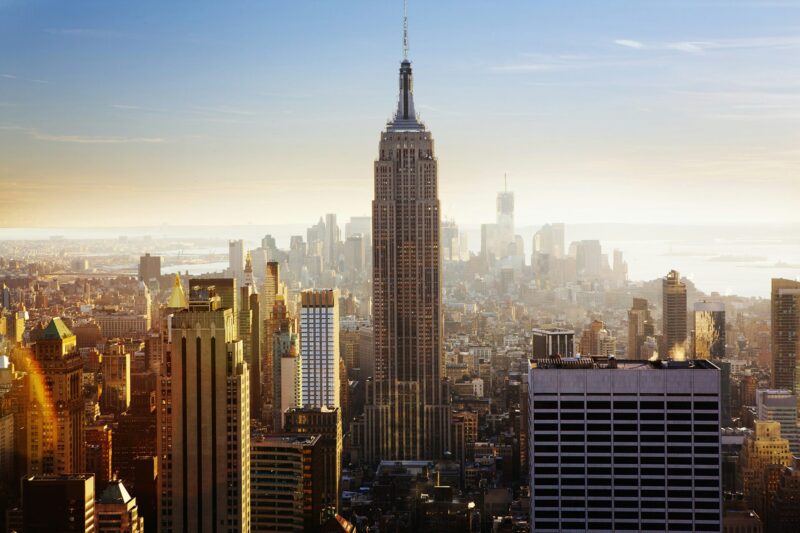
An icon of the New York skyline, the Empire State Building is one of Manhattan’s most recognizable symbols and an essential landmark among the places to visit in New York. This 103-story giant offers an unforgettable experience for anyone wanting to admire the city from a privileged perspective.
From the 86th-floor observatory, you can enjoy a 360° view that spans all of New York, including the Brooklyn Bridge, Central Park, the Statue of Liberty, and many other iconic city landmarks. This floor features both an enclosed observation gallery and an open-air area, allowing you to photograph the panorama without any visual obstructions.
Even more spectacular is the experience at the Top Deck on the 102nd floor, recently renovated. With floor-to-ceiling windows, this fully enclosed observatory offers unparalleled views that, on clear days, stretch up to 80 miles. From this extraordinary height, you can see six states: New York, New Jersey, Connecticut, Pennsylvania, Massachusetts, and Delaware.
Empire State Building: hours and tickets
Opening hours vary throughout the year. In general, the building is open every day, with hours ranging from 9:00 AM to 12:00 AM depending on the season. For example:
- From February to March: 10:00 AM–10:00/11:00 PM
- From May to June: 9:00 AM–12:00 AM
You can purchase Empire State Building tickets on our website. Prices start at $53 for adults and $48 for children.
An interesting option is the AM/PM Experience ticket, which allows you to visit the observatory twice in the same day: once during daylight and once at night to admire the city lights.
Empire State Building: fun facts
Despite its massive weight of about 370,000 tons, the construction of the Empire State Building took just 13 months and 15 days—a record time for the era. Opened on May 1, 1931, it held the title of the tallest building in New York for about 40 years, until the construction of the Twin Towers.
The building’s roof was originally designed as a landing platform for airships. Today, the Empire State Building is known for its LED lighting system, which can create 12 million different color combinations and changes for special events and holidays.
Among the building’s lesser-known secrets are an old bank vault in the basement, underground wind tunnels, and the fact that restoring the lobby ceiling took longer than constructing the entire building.
4. Top of the Rock
Located at 30 Rockefeller Plaza, Top of the Rock offers three levels of panoramic terraces that deliver some of the most postcard-worthy views among all the things to see in New York. Although it’s not the tallest building in the city, its strategic location in the heart of Manhattan makes it a prime vantage point.
Top of the Rock: what you can see
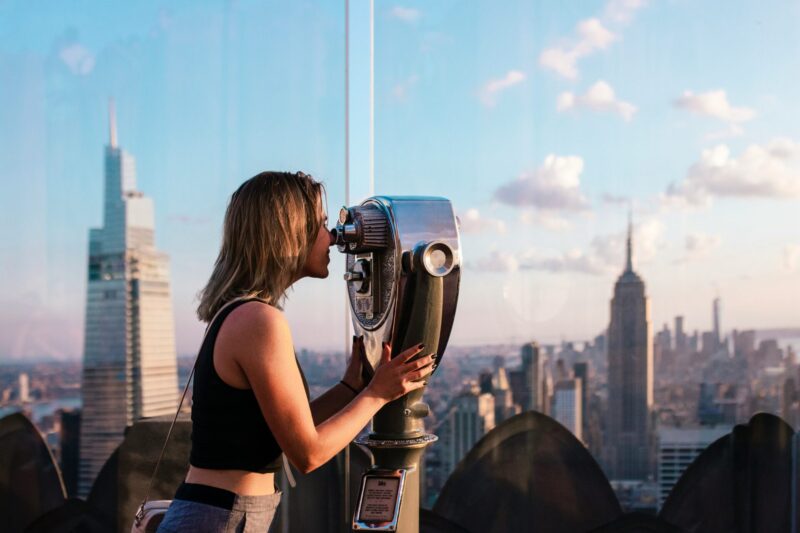
From Top of the Rock, you can enjoy a 360° panoramic view of Manhattan. The terraces are spread across three levels: the 67th, 69th, and 70th floors. The top-floor terrace has no protective glass, allowing you to take photos without unwanted reflections. To the north, you’ll admire Central Park in all its expanse, while to the south the Empire State Building dominates the view—especially striking when lit up at night.
On clear days, your view can stretch as far as One World Trade Center and the Statue of Liberty. The Chrysler Building is also visible, although partially obscured by the MetLife Building.
Top of the Rock: comparison with other observatories
Compared to other New York observatories, Top of the Rock sits at a height of 259 meters, making it the lowest among the major viewpoints. This feature actually turns into an advantage: it offers the best views of Central Park and the Empire State Building—views you simply can’t get in the same way from other observatories. Seeing that vast green rectangle stretching northward, surrounded by a concrete jungle, really helps you understand Manhattan’s urban design: pure geometry applied to beauty.
Unlike the Empire State Building, which has protective grates that partially obstruct the view, Top of the Rock features plexiglass panels that shield against the wind while keeping the view clear. The ticket price ($53 for adults) is average compared to other city observatories.
Top of the Rock: hours and prices
The observatory is open every day from 9:00 AM to 10:00 PM, with the last elevator going up at 9:10 PM. A standard ticket for adults costs $53, while for children aged 6 to 12, the price is $48.
It is recommended to purchase Top of the Rock tickets online in advance, selecting the day and time of your visit.
The average visit lasts about 45–60 minutes, but there are no time limits, and you can stay on the terraces until closing. Being a major classic, Top of the Rock is included in almost all the main New York attraction passes.
5. Brooklyn Bridge
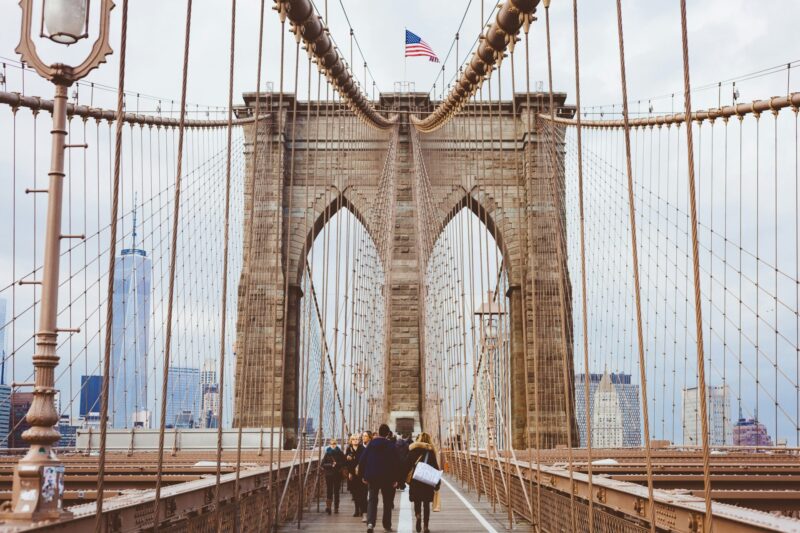
When it was completed in 1883, it was the longest suspension bridge in the world. Its iconic Gothic granite arches were built to last forever. To convince New Yorkers it was safe, they had 21 elephants from the Barnum circus march across it! This engineering masterpiece now offers an unforgettable experience to anyone who walks across it. Discover our Brooklyn Bridge sunset tour.
Brooklyn Bridge: pedestrian walkway
The pedestrian walkway of the bridge is elevated above the lanes for cars, allowing you to enjoy the view without traffic disturbances. The full path is about 2 km, with a slight incline toward the center that then descends. Walking the entire bridge takes about 30–45 minutes at a leisurely pace, but considering stops to take breathtaking photos, it’s advisable to allow a full hour. During the walk, be especially careful not to enter the bike lane, as many cyclists travel at high speed. Along the way, you can admire the network of cables and suspenders that form what is called a “steel jungle.” The legendary Brooklyn Bridge appears in several classic films such as Once Upon a Time in America (1984), Sex and the City (The Movie, 2008), and disaster films like I Am Legend (2007), Godzilla (1998), and Spider-Man (2002).
Brooklyn Bridge: when to visit
The best time to cross the bridge is at sunrise or sunset. At sunrise, it’s almost deserted, while at sunset, the sun paints the skyline with golden hues. For the best photos, go to the bridge at dusk, when the city lights start to turn on. The bridge is freely accessible at all hours, but it’s best to avoid particularly windy days, as the wind can become quite strong while crossing. In the summer, consider bringing a bottle of water, as there are no restrooms or food and drink kiosks along the path.
Brooklyn Bridge: view of Manhattan
The recommended direction to fully enjoy the view is from Brooklyn toward Manhattan. This perspective allows you to walk with the city in front of you, creating the perfect opportunity for memorable photos of the New York skyline. Midway across, you can also spot the Statue of Liberty in the distance. During the crossing, you’ll be able to recognize the main skyscrapers: the Empire State Building, the Chrysler Building, the Freedom Tower, and many others. It’s especially thrilling to admire the lights of the buildings in the Financial District, which in the evening create striking geometric patterns on the facades.
6. High Line
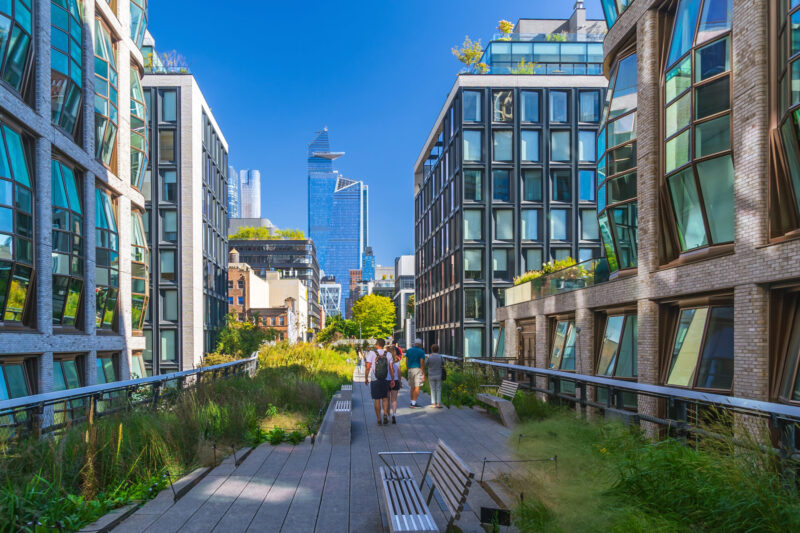
Transformed from an abandoned elevated railway into a beautiful urban park, the High Line is one of the most successful and original urban redevelopment projects among things to see in New York. This elevated green space offers a different perspective of the city, allowing you to admire it from about 10 meters above the ground.
High Line: what it is
Imagine an old elevated railway track, abandoned for years, rusted, and destined for demolition, which instead of disappearing becomes the coolest park in the world.
The transformation project that turned the West Side Line elevated railway, inaugurated in 1934 and decommissioned in 1980, into the magnificent High Line park began in 2006, with the first section opening in 2009, the second in 2011, and the third in 2014. Today, this park attracts over 5 million visitors a year, more than the Statue of Liberty.
The design is inspired by the wild landscape that had naturally grown on the abandoned tracks, incorporating over 200 plant species. In some areas, the original tracks have been preserved and integrated into the path, creating a striking dialogue between the industrial past and the green present.
High Line: route and entrances
The High Line park stretches for 2.33 km across Manhattan’s West Side, from the Meatpacking District to Hudson Yards. Walking the entire path takes about an hour, but here too, much depends on stops to enjoy the views.
The High Line has 11 access points, 6 of which are also accessible to people with disabilities via elevators. The main entrances are at Gansevoort Street in the south and 34th Street in the north. The park is open every day from 7:00 AM, with closing times varying by season (until 7:00 PM in winter and 11:00 PM in summer).
High Line: attractions along the route
Along the walk, numerous viewpoints offer spectacular views. The 10th Avenue Square and Overlook is an urban amphitheater overlooking the traffic below. Equally notable are the Diller-von Furstenberg Sundeck, with views of New Jersey, and The Rail Yards, which offers 360° panoramas of the Hudson River.
Near the High Line, you’ll find unmissable attractions such as Chelsea Market, housed in the former Oreo cookie factory, and the Whitney Museum of American Art at the southern end. In 2019, Hudson Yards opened, a new commercial and residential hub that includes the panoramic structure The Vessel. Discover our High Line, Hudson Yards, and Greenwich Village tour.

7. 9/11 Memorial e Museo
Talking about the 9/11 Memorial & Museum is not like describing any other New York attraction. Here, you enter the city’s wounded and beating heart. A deeply moving place of remembrance, the 9/11 Memorial stands exactly where the Twin Towers once rose, offering a reflective experience among New York sights that leaves an indelible mark on visitors’ hearts.
9/11 Memorial: what to see
The Reflecting Pools, two large square basins that occupy the entire original footprint of the Twin Towers, represent the heart of the memorial. The water cascades 30 feet down into a central void that seems to never end. Along the entire perimeter, the names of the 2,983 victims of the September 11, 2001 and February 26, 1993 attacks are engraved. The sound of the water creates a unique atmosphere, muffling the noise of the city. Among the oak trees surrounding the area stands the Survivor Tree, the only tree that survived the collapse of the Twin Towers.
9/11 Museum: main exhibits
The museum is almost entirely underground. Going down those escalators physically takes you to the original foundations of the World Trade Center. In Foundation Hall, you can see the last remaining original wall and the Last Column, the final column removed from the site. Especially moving is the In Memoriam Exhibition, dedicated to the lives of the victims, featuring photographs and personal items donated by their families.
9/11 Memorial: hours and tickets
The Memorial is free and open daily from 8:00 AM to 8:00 PM. The Museum is open Wednesday through Monday from 9:00 AM to 7:00 PM (closed on Tuesdays). Tickets for the 9/11 Museum cost about $38 for adults, $32 for seniors and teens (ages 13–17), and $25 for children (ages 7–12). Admission is free on Mondays from 5:30 PM to 7:00 PM (last entry of the day), but online reservation is required. With this option, it’s impossible to see everything in just an hour and a half.
8. Times Square
Se Manhattan è il corpo di New York, Times Square è il suo sistema nervoso centrale in preda a un eccesso di caffeina. Nessun viaggio a New York è completo senza immergersi nell’ipnotico vortice di luci di Times Square, un crocevia emblematico che rappresenta l’anima pulsante della città. Questo straordinario incrocio, dove Broadway incontra la Seventh Avenue, è diventato il luogo più visitato della Grande Mela.
Times Square: what to expect
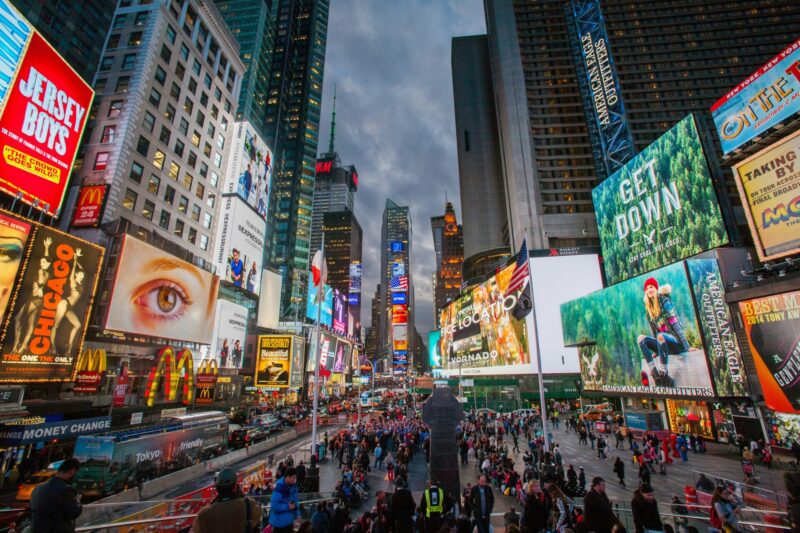
Times Square isn’t a square in the traditional sense, but an urban intersection transformed into an explosion of energy and color—a true canyon of light. The enormous bright screens and billboards create an unparalleled visual spectacle, visible for blocks when night falls. The central area, between 42nd and 47th Street, is completely pedestrian, allowing you to explore without the distraction of traffic.
The best vantage point is above the Broadway ticket booth. Climb those red stairs, sit down, and watch the human spectacle below. You’ll see it all: street performers, including the famous Naked Cowboy, now a true institution, people rushing by, mesmerized tourists, and the well-known costumed characters (a tip: if you take a photo with them, expect them to ask for a hefty tip!). Want to make a statement? Consider renting a billboard in Times Square.
Times Square: best times to visit
Although Times Square is perpetually crowded, the early morning hours offer a calmer atmosphere. However, the most striking experience comes after sunset, when the dazzling concentration of lights reaches its full brilliance. For a truly special occasion, consider New Year’s Eve, when about a million people gather to watch the famous ball drop from the top of One Times Square at 11:59 PM.
Some expert survival tips:
The “Midnight Moment”: Few people know this, but every evening from 11:57 PM to midnight, all the digital billboards synchronize to display a contemporary digital artwork. For three minutes, the ads disappear, and the square transforms into a coordinated art gallery. It’s mesmerizing.
Want to have lunch here?Times Square is the land of expensive chains and tourist traps. Take a couple of steps toward 9th Avenue (Hell’s Kitchen), and you’ll find authentic restaurants, reasonable prices, and excellent food less than a ten-minute walk away.
Panoramic photos: To capture the full grandeur of the square, head toward 47th Street and frame your shot looking south. You’ll get the perfect perspective of the “bowtie,” the point where Broadway and 7th Avenue intersect.
Times Square: nearby attractions
The surrounding area is the heart of the Theater District, with over 39 historic theaters where American musicals have found their global capital. Nearby, you’ll find numerous flagship stores of famous brands, such as the Disney Store, M&M’s World, and Hershey’s Chocolate World. For cultural experiences, you can get tickets to Madame Tussauds Wax Museum, featuring over 200 statues of famous personalities, just a 3-minute walk away.
9. Broadway and the musicals
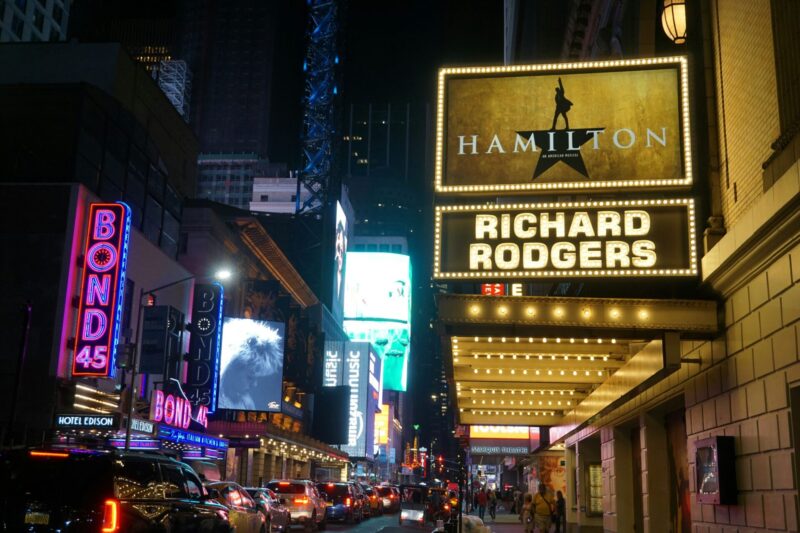
You can see all the monuments you want, but until you sit in a historic theater, with the lights dimming and the orchestra striking the first notes, you haven’t experienced the true soul of the Big Apple. The Theater District, with its 41 active theaters, represents the beating heart of American entertainment, making Broadway a must-see during any visit to the city. On Broadway, there are no “good” actors—there are the best. Every night, thousands of performers take the stage live with a precision and energy that takes your breath away. Whether it’s a timeless classic like The Lion King or the latest critically acclaimed hit like Hamilton, the level of production—sets, costumes, lighting—is unmatched anywhere else in the world.
Broadway: how to choose a show
Choosing a show mainly depends on personal taste. Among the most popular musicals are timeless classics like The Lion King and Chicago, with ratings above 4.5/5, or more recent productions like MJ The Musical and The Great Gatsby. For families with children, it’s important to check that the show is age-appropriate, as many theaters do not admit children under 4.
Broadway: where to buy tickets
Tickets for Broadway shows can be purchased online well in advance. Alternatively, the TKTS booths in Times Square offer discounts of 30–50% for same-day performances. Average prices are around $89, with the most popular musicals reaching $99.
Broadway: most famous theaters
Among the most renowned theaters are the Gershwin Theatre (3,193 seats), home to Wicked; the Minskoff Theatre (1,621 seats), hosting The Lion King; and the Majestic Theatre, the historic home of The Phantom of the Opera.
10. MoMA Museum
If you’re in New York and want to understand why this city became the world capital of creativity, you absolutely have to step inside the MoMA (Museum of Modern Art).
Forget the idea of a boring museum. The MoMA, on 53rd Street, is a vibrant, bright place—the sanctuary of modern art.
New York’s MoMA houses one of the most prestigious collections in the world, with over 150,000 works of art.
MoMA: must-see works
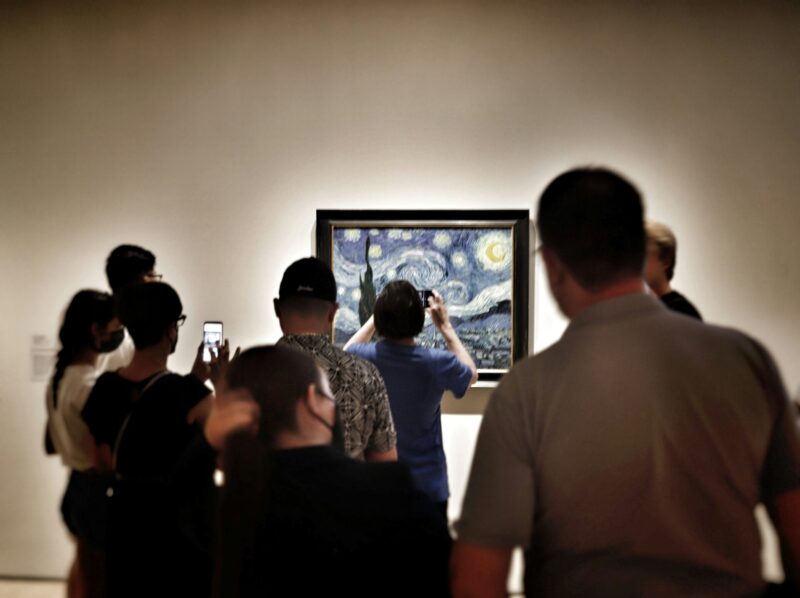
Stepping into the fifth-floor galleries is a bit like having a close encounter with celebrities. You’ll come face-to-face with Van Gogh’s Starry Night (be prepared—there’s always a bit of a crowd, but the thrill is worth it), Monet’s Water Liliesthat cover entire walls, offering an incredible sense of calm, and Andy Warhol’s iconic Campbell’s Soup Cans.
Other treasures not to be missed include Picasso’s Les Demoiselles d’Avignon, considered the manifesto of Cubism; Salvador Dalí’s The Persistence of Memory; and Marc Chagall’s I and the Village. Certainly, Jackson Pollock’s One: Number 31 represents Abstract Expressionism at its highest.
Seeing Picasso’s or Pollock’s brushstrokes in person has an impact that no Instagram photo could ever give you.
MoMA: hours and prices
The museum is open daily from 10:30 AM to 5:30 PM, with extended hours until 8:30 PM on Fridays. You can purchase MoMA tickets for New York on our website. Admission costs $30 for adults, $25 for seniors (65+), and is free for those under 16. Tickets include access to all galleries and special exhibitions. A great opportunity for locals is free entry on Friday evenings from 5:30 PM to 8:30 PM through the Uniqlo initiative.
MoMA: tips for your visit
First of all, it’s recommended to start your visit on the fifth floor, where the most famous masterpieces are located. Plan at least half a day to fully enjoy the collections. Sundays tend to be less crowded, while rainy days are particularly busy. To avoid long waits, purchase tickets online in advance. Inside the museum, you’ll find several dining options. If you want a special lunch break, there’s The Modern, a Michelin-starred restaurant, but for something more casual, the café on the second floor offers a beautiful view of the sculpture garden.
Don’t underestimate the Design Store: Even if you’re not into souvenirs, the MoMA shop is a temple of good taste. You’ll find home goods and gadgets that are true works of art at affordable prices.
Use the museum app: Bring your headphones! The MoMA offers a fantastic audio guide directly on your smartphone (there’s free Wi-Fi everywhere), with commentary from artists and curators explaining the secrets behind each artwork.
11. SoHo Neighborhood
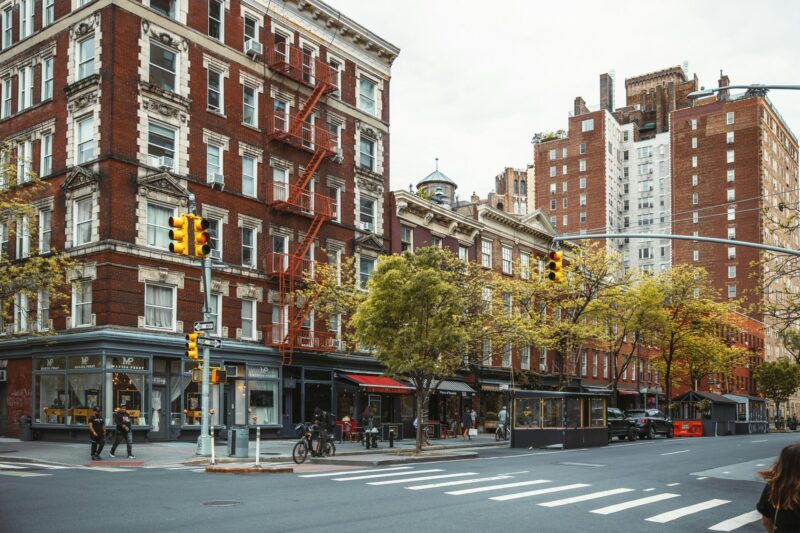
South of Houston Street, between Canal Street and Sixth Avenue, lies SoHo (its name is an acronym for South of Houston Street), a charming neighborhood that blends luxury and accessibility through cobblestone streets and unique architecture.
The atmosphere in SoHo is unique, a captivating blend of industrial history and modernity. Even the traffic lights here have historical value, dating back to the early 19th century. Although it has become one of the most expensive neighborhoods in New York, SoHo has retained its authentic charm thanks to its cobblestone streets and distinctive architecture.
SoHo: what to see
The Cast Iron District is the historic heart of SoHo, where you can admire the iconic cast-iron façade buildings dating back to the mid-1800s. Once textile factories and warehouses, they now house some of the city’s most expensive lofts. Greene Street features the longest row of these structures, particularly between Canal and Grand Street. Don’t miss the Queen and King buildings (at numbers 72 and 28, respectively), masterpieces by architect Isaac Duckworth. Other points of interest include the Museum of Ice Cream, Color Factory New York, and the striking Trompe L’Oeil mural by Richard Haas on Prince Street.
SoHo: shopping and galleries
SoHo is undoubtedly a shopping paradise in New York. On Broadway, you’ll mainly find large chains like H&M, Uniqlo, and Nike. For more exclusive boutiques, head to Prince Street, Broome Street, and Spring Street, where prestigious brands like Louis Vuitton, Chanel, and Prada have their flagship stores. The neighborhood also hosts excellent art galleries, a legacy of its artistic past, such as the Franklin Bowles Gallery and the Drawing Center, the only American institution dedicated exclusively to historic and contemporary drawings.
A paradise for “Foodies”
In SoHo, the food is simply amazing. It’s home to historic spots and legendary bakeries. This is where the Cronut (a mix between croissant and donut) was born at Dominique Ansel, and it’s also where you’ll find bars and bistros with outdoor tables—perfect for people-watching while sipping a matcha latte.
12. Coney Island
If you want to take a break from the frantic pace of the skyscrapers and discover New York’s most nostalgic, quirky, and authentic side, then you absolutely have to come with us to Coney Island.
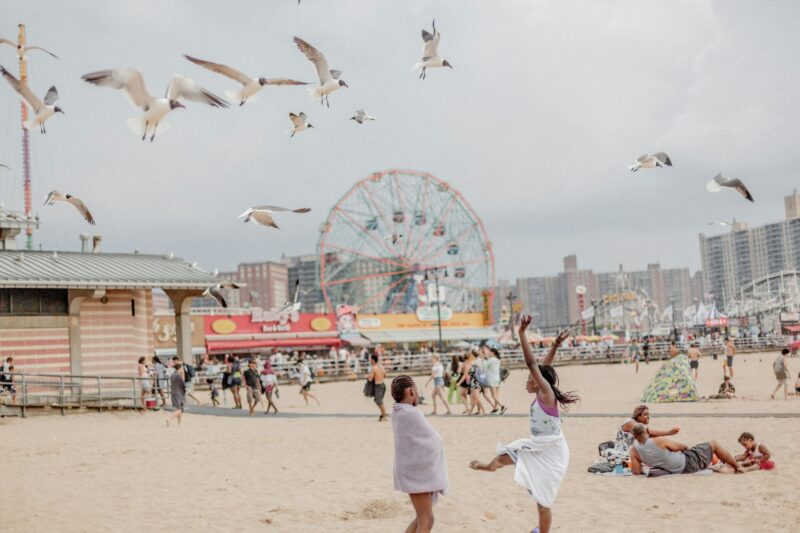
South of Brooklyn, Coney Island is an explosion of color, fun, and beachside vibes, offering a refreshing break from Manhattan’s urban density and making this area an exciting alternative among New York’s must-visit spots.
Coney Island: things to do
The beating heart of this area is definitely Luna Park, with its many attractions, including the historic Wonder Wheel Ferris wheel from 1920 and the Cyclone roller coaster from 1927. Another must-visit stop is the New York Aquarium, the city’s only aquarium, where you can see sea lions, sharks, and many other marine creatures. You can’t say you’ve been to Coney Island without eating a hot dog from Nathan’s. This is where the American icon was born, and every July 4th, the famous hot dog eating contest takes place here. Even if the line seems long, trust us: enjoying an “original” hot dog while sitting on the beach is a fundamental rite of passage.
There’s something magical about walking along the Riegelmann Boardwalk, the historic wooden promenade that runs for miles along the ocean. You’ll smell the salt air mingling with the scent of popcorn. It’s the perfect spot to watch New York’s most diverse humanity: street performers, fishermen on the pier, and families enjoying the sun.
Coney Island: how to get there
Getting to Coney Island from Manhattan is easy. Just take one of the four subway lines (D, F, N, or Q) to the Coney Island-Stillwell Avenue station. The trip takes about 40–50 minutes and crosses the Manhattan Bridge, offering a spectacular view of the Brooklyn Bridge. Here you’ll find a detailed guide on our blog about how to get to Coney Island and what to see.
Coney Island: best time to visit
Summer is undoubtedly the ideal time to fully enjoy the beach and the attractions. During the summer season, don’t miss the Friday night fireworks. In June, there’s also the colorful Mermaid Parade, the largest art parade in the United States.
Comparison table
| Attraction | Opening hours | Ticket price (adults) | Visiting time | Main feature |
| Central Park | 6:00-1:00 | Free | 4-5 hours | 340 hectares of urban greenery |
| Statue of Liberty | 8:30-15:30 | $33 | Half day | Symbol of freedom and hope |
| Empire State Building | 9:00-24:00 | $53 | 1-2 hours | 360° panoramic view from the 86th floor |
| Top of the Rock | 9:00-22:00 | $53 | 45-60 minutes | View of Central Park and the Empire State Building |
| Brooklyn Bridge | 24/7 | Free | 30-45 minutes | 2 km of panoramic walk |
| High Line | 7:00-19:00/23:00 | Free | 1 hour | Elevated park on former railway |
| 9/11 Memorial | 8:00-20:00 | Free (Memorial) $38 (Museum) | N/A | Two commemorative basins |
| Times Square | 24/7 | Free | N/A | Illuminated and pedestrian intersection |
| Broadway | Varies per show | $89-99 | 2-3 hours | 41 historic theaters |
| MoMA | 10:30-17:30 | $30 | Half day | 150,000 works of modern art |
| SoHo | – | Free | N/A | Historic cast iron buildings |
| Coney Island | Months: Mar-Oct | Varies by attraction | N/A | Historic Luna Park |
New York unquestionably remains one of the most captivating destinations in the world, capable of offering unforgettable experiences for every type of traveler. The variety of attractions presented in our guide showcases the extraordinary cultural and architectural richness of the Big Apple.
Planning a trip to New York might initially seem complicated. However, by following our tips and focusing on the 12 attractions described, you’ll be able to capture the city’s authentic essence. Get ready to walk a lot, be amazed by the massive scale of its skyscrapers, and let yourself be charmed by the unique character of each neighborhood.